


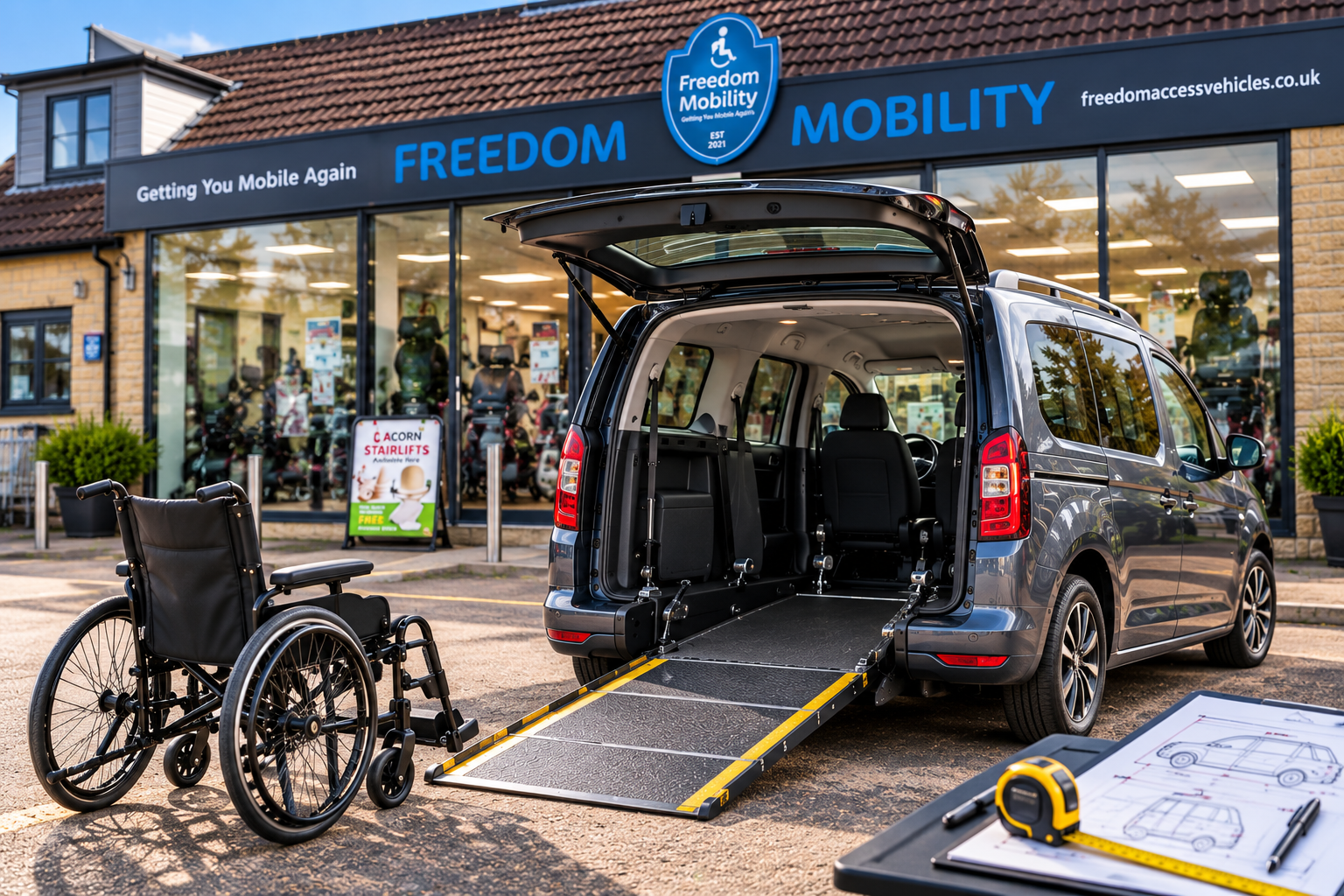
How to Measure for a Wheelchair Accessible Vehicle (WAV)
Buying a wheelchair accessible vehicle (WAV) isn’t simply a case of finding a vehicle that’s big enough to accommodate a wheelchair. Wheelchairs and their users vary enormously, as do WAV conversions, so taking a few measurements before choosing a vehicle can make the process considerably easier.
The good news is that you don’t need any specialist equipment. A tape measure, something to record the measurements and, ideally, another person to help are usually all you need.
In this guide, we’ll explain which measurements matter, how to take them and why trying a wheelchair and its user in the vehicle itself is always an important part of choosing the right WAV.
Why are wheelchair accessible vehicle measurements so important?
Two wheelchairs can look similar but have very different dimensions. Powered wheelchairs, tilt-in-space chairs, headrests, leg supports, control units and other equipment can make a significant difference to the overall size.
The same applies to wheelchair accessible vehicles. Even two WAVs based on the same make and model of car can potentially have different internal dimensions if they have been converted differently.
There are several things we therefore need to establish:
- Can the wheelchair get through the vehicle’s entrance?
- Is there sufficient headroom for the wheelchair user?
- Is the ramp or lift suitable for the wheelchair and user?
- Is there enough room inside to position and secure the wheelchair correctly?
- Can the wheelchair user travel comfortably?
- Is there sufficient space for the other people and equipment you regularly carry?
Getting the measurements right can considerably narrow down your choice of suitable WAVs.
1) Measure the overall width of the wheelchair
Start by measuring the wheelchair at its widest point. Don’t assume that the seat width represents the overall width of the chair. Depending on its design, the widest points might be the wheels, hand rims, armrests or another component.
Powered wheelchairs may also have controls or other equipment protruding from one side. Measure from the outermost point on one side to the outermost point on the other, with the wheelchair configured exactly as it would normally be when travelling. This measurement helps determine whether the wheelchair can comfortably pass through the WAV’s entrance and along the route to its travelling position.
2) Measure the overall length of the wheelchair
Next, measure the wheelchair from its furthest forward point to its furthest rearward point.
Again, include everything that will remain fitted when travelling. Depending on the wheelchair, this could include:
– Footrests or leg supports
– Anti-tip wheels
– Headrest supports
– Rear-mounted equipment
– Batteries or power units
Don’t simply measure the wheelbase or frame. The complete overall length is important because there must be sufficient usable space inside the WAV for the wheelchair to reach its designated travelling position and for the appropriate restraint or docking system to be used.
3) Measure the wheelchair user’s seated height
This is one of the most important WAV measurements – and one that’s easy to underestimate. With the person sitting in their wheelchair in their normal travelling position, measure vertically from the ground to the highest point of their head. If the wheelchair has a seat or suspension system that settles differently when occupied, taking this measurement with the person actually seated in the chair will give a more useful result. Don’t simply add the person’s sitting height to the wheelchair seat height, as this may not accurately represent their real travelling position.
The wheelchair user’s total seated height needs to be considered against both the height of the vehicle entrance and the available headroom once inside. Remember that getting through the entrance is only part of the equation. The wheelchair user must also have adequate clearance when travelling and should be able to sit in their normal, comfortable position without having to duck or alter their posture.
4) Consider headrests and other equipment
If a headrest, postural support or other equipment extends above the wheelchair user’s head, measure to the highest point that needs to pass through the vehicle entrance.
It can therefore be useful to record two height measurements:
Occupied height: from the ground to the top of the wheelchair user’s head.
Maximum overall height: from the ground to the highest fixed part of the occupied wheelchair and its equipment.
This is particularly relevant with more complex powered and tilt-in-space wheelchairs.
5) Measure the wheelchair and user in their normal travelling configuration
Some wheelchairs can change shape considerably. A powered chair may have adjustable seating, while a tilt-in-space wheelchair can alter the position of the user and the overall dimensions of the chair.
For WAV purposes, measurements should reflect the configuration in which the wheelchair will actually be used during the journey. It’s also important to check the wheelchair manufacturer’s instructions. Not every wheelchair, or every possible seating configuration, is necessarily approved or recommended for use as a seat in a motor vehicle. If you’re unsure, check the wheelchair’s instructions or contact its manufacturer or supplier.
6) Check the combined weight of wheelchair and user
Dimensions aren’t the only consideration. Find out the weight of the wheelchair and, where required, the combined weight of the wheelchair and its occupant. Powered wheelchairs can be considerably heavier than manual chairs, particularly when batteries and specialist seating systems are included. This information can be important when checking the rated capacity of a vehicle’s wheelchair ramp or lift and the vehicle’s permitted carrying capacity. Never assume that a ramp or lift is suitable simply because the wheelchair physically fits on it. Its manufacturer’s stated weight limit must also be observed.
7) Check the vehicle entrance
Once you have the wheelchair measurements, they can be compared with the WAV.
The entrance needs to accommodate the complete wheelchair and its user, so important considerations include:
– Usable entrance width
– Usable entrance height
– The shape of the opening
– Any trim, fittings or equipment that reduce the usable opening
– The transition between the ramp and vehicle floor
Published dimensions are useful for narrowing down the options, but they don’t always tell the whole story. The shape of the wheelchair and vehicle entrance can make a difference, which is another reason why a physical trial is so valuable.
8) Check the ramp
Ramp width should comfortably accommodate the wheelchair at its widest point, but width isn’t the only consideration. Also consider how easily the wheelchair can be manoeuvred onto the ramp and whether its ground clearance, footrests or anti-tip equipment create any problems when moving between the ground, ramp and vehicle floor.
Ramp gradient can vary according to the design of the conversion and, in some cases, where the vehicle is parked. The strength required to push a manual wheelchair up a ramp can also be important. For a powered wheelchair, check that it can negotiate the ramp safely in accordance with the wheelchair manufacturer’s instructions. If the WAV uses a wheelchair lift rather than a ramp, check the lift platform’s usable dimensions and rated weight capacity.
9) Check the space inside the WAV
A wheelchair fitting through the rear or side entrance doesn’t automatically mean that the WAV is suitable. There must also be enough usable space to manoeuvre the chair into its intended travelling position and secure it correctly. The Research Institute for Disabled Consumers (RiDC), for example, uses a reference wheelchair measuring 1,200mm long and 700mm wide when assessing vehicle accessibility. However, these dimensions shouldn’t be treated as a universal definition of a wheelchair or a guarantee that a particular WAV will suit an individual user. Your own wheelchair measurements are what matter. You should also consider whether there is enough space for whoever will be securing the wheelchair to access the appropriate restraint points.
10) Don’t forget the wheelchair restraints and seatbelt
A wheelchair accessible vehicle doesn’t simply need enough floor space for the chair. When travelling in a wheelchair, both the wheelchair and its occupant need to be secured using the appropriate systems for the vehicle, wheelchair and user. In many passenger WAVs this involves a wheelchair tie-down and occupant restraint system, often referred to as WTORS. Other vehicles and wheelchairs may use approved docking systems. Importantly, securing the wheelchair and restraining the occupant are separate functions. A wheelchair’s normal lap belt or postural support should not automatically be assumed to replace the vehicle’s occupant restraint. Always follow the instructions supplied by the wheelchair, WAV conversion and restraint-system manufacturers.
11) Think about visibility and comfort
A WAV may accommodate a wheelchair perfectly well in dimensional terms but still not provide the best travelling experience. Once inside, check the wheelchair user’s position. Can they sit naturally and comfortably? Can they see through the windows? Can they communicate easily with the driver or other passengers? Is there comfortable clearance around their head and body? RiDC specifically recommends checking that a wheelchair user can sit comfortably and upright without ducking their head and has sufficient space above them while travelling.
These considerations can make a considerable difference, particularly on longer journeys.
12) Measure your driveway or garage too
There is one more set of measurements that’s easy to overlook: where the WAV will be kept and used. Measure your garage, driveway or regular parking area and compare this with the external dimensions of the vehicle. For a rear-entry WAV, remember that you need space behind the vehicle to open the tailgate or rear doors and deploy the ramp or lift, as well as sufficient room for the wheelchair to approach and leave it. If you’re considering a side-entry vehicle, you’ll need suitable clearance alongside it. Think about the places you visit regularly too. A larger WAV might provide excellent interior space but may be less convenient if you frequently use a small garage, narrow driveway or restricted parking area.
WAV measurement checklist
Before looking for a WAV, record the following:
Wheelchair
– Overall width at the widest point
– Overall length, including footrests and other equipment
– Maximum overall height
– Wheelchair weight
– Any particularly low components or limited ground clearance
Wheelchair user
– Overall seated height from the ground to the top of the head
– Normal travelling/seating position
– Any additional postural or medical equipment that needs to travel with them
Combined
– Combined wheelchair and occupant weight where required for checking ramp or lift capacity
– Overall dimensions in the wheelchair’s normal travelling configuration
At home
– Garage dimensions, if applicable
– Driveway or parking space
– Space available behind or beside the vehicle to deploy the ramp or lift and manoeuvre the wheelchair
Keeping these measurements with you when looking at WAVs makes comparing different vehicles considerably easier.
Does measuring guarantee that a WAV will be suitable?
No – and this is probably the most important point in this guide.
Measurements are an excellent way of identifying vehicles that are likely to be suitable, but nothing replaces trying the actual wheelchair and wheelchair user in the WAV. You need to establish not only that the chair physically fits, but that the user can enter and leave the vehicle safely, travel comfortably and be correctly secured. Different conversions can also result in different entrance heights, ramp arrangements, floor heights and wheelchair positions, even when they’re based on the same underlying vehicle.
Try before you buy
At Freedom Access Vehicles, we have more than 25 years of experience in the mobility industry and we have a wide selection of wheelchair accessible vehicles available.
If possible, bring the wheelchair that will actually be used in the vehicle when you visit us. We can then help you compare suitable WAVs and look at practical considerations such as access, headroom, wheelchair position and available passenger space. Taking a few measurements beforehand is an excellent starting point, but seeing how the wheelchair and its user fit a particular WAV is the best way to determine whether you’ve found the right vehicle. Contact us for a free, no-pressure demonstration.
ADDRESS
‘The Old Wagonworks’
Ludwell
Nr. Shaftesbury
Dorset
SP7 9HH